At Crosswave Youth Network we build youth mobility projects that do more than move people from A to B. We design experiences that move ideas, confidence, and practical skills into communities long after an exchange ends. If you’re a youth worker, teacher, funder, or curious young person, here’s a clear look at how our approach works and why it consistently produces practical outcomes.

1. Purpose first: clear outcomes, not vague vibes
Every Crosswave activity starts with a simple question: what will participants be able to do afterwards? That shifts planning away from flashy sessions toward measurable outcomes. For a SkillShift workshop that might mean “create a basic brand identity and social campaign.” For Offline On Point, the outcome could be “set up a personal digital-wellness plan and lead a peer session.”
Defining outcomes early keeps activities short, focused, and repeatable and it gives local partners a clear reason to host or replicate a module.
2. Non-formal education that actually teaches
We use non-formal and informal education because these methods let people learn by doing, which is how skills stick. Think short sprints, peer coaching, mini-projects, and live feedback instead of slides. Participants are co-creators: they plan, prototype, deliver, and reflect.
This isn’t “play time.” It’s structured practice. Small teams finish each module with a real output: a mini-campaign, a prototype, a community action plan. Those outputs are the bridge from learning to local impact.
3. Short cycles:
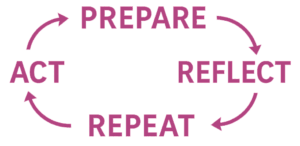
Our sessions run in short cycles. Each cycle contains a preparation action, a focused implementation window, and a structured reflection. Short cycles make progress visible and cut waste: if something doesn’t work, the next cycle fixes it.
This rhythm also helps inclusion. Reflection asks: who couldn’t join, why, and how do we change that next time? Those fixes are built into the workflow, not tacked on at the end.
4. Open-source educational materials — because sharing is scale
Everything we produce, session plans, facilitator notes, evaluation checklists, is open-source and practical. Our toolkits include learning outcomes, time budgets, materials lists, and low-cost alternatives so a small school in Graz or a youth centre in Sarajevo can run a module with minimal prep.
Open materials reduce gatekeeping. They also invite adaptation: local teams translate, tweak, and remix content so it fits their context.
5. Partnerships that increase reach, not red tape
We partner with schools, municipalities, NGOs, and private sector mentors, but with a clear rule: partners must add capacity or reach. A municipality might offer a venue and local publicity; a business may volunteer mentors for a SkillShift team. That keeps projects nimble and locally relevant.
Partnerships also allow us to scale successful pilots across the EU without losing local ownership. We test in Vienna and Graz, learn fast, then share the toolkit for replication elsewhere.
6. Inclusion and sustainability — practical, measurable steps
Inclusion is operational. We budget travel support, design accessibility plans, and provide mentoring for participants facing barriers. Sustainability isn’t only about low-waste events; it’s about designing projects that keep running after funding ends. We track practical indicators: local replication count, participant-led initiatives started after the exchange, and the tangible outputs produced.
Those measures help us answer a crucial question funders and partners ask: did this exchange produce continuing value?
7. Digital empowerment meets lived experience
Digital skills are woven into our projects, from AI literacy sessions to secure online collaboration. But we balance tech with human practice. Offline On Point, for example, teaches digital mindfulness alongside concrete privacy skills so participants can make better choices online and in life.
8. The team — structure plus heart
Crosswave blends technical organisation with people-first facilitation. Engineers, auditors, youth workers and creatives come together to design precise plans that still leave room for serendipity. That balance explains why our exchanges run on time and end with real proposals.
9. How to partner or run a module
If you want to run a Crosswave module, here’s how it usually goes:
• You tell us your context and objectives (school, local youth centre, municipality).
• We match the appropriate toolkit and suggest budget/support options.
• We provide facilitator notes and mentor suggestions.
• We follow up to help you replicate or scale.
• Together we deliver the module and run a structured evaluation.
Every big impact starts with a small hello.
See our team and take the first step toward collaboration.